Commercial & Specialty Turf
Commercial Artificial Turf in Valley Stream, NY
Valley Stream Artificial Grass installs durable, low-maintenance commercial artificial turf for businesses and property managers, sized around area, access, use level, preparation and drainage for the specific site.
Commercial-grade planning for access, drainage, use level and maintenance expectations — not a residential lawn applied to a commercial site.
Request a Turf Estimate
Tell us about your project. We'll follow up to schedule a site-specific evaluation.
Who Should Call
A business or property manager wants a durable, low-maintenance surface that holds up to daily foot traffic.
The Outcome
A durable commercial surface that handles foot traffic, reduces ongoing maintenance and keeps a consistent appearance year-round.
Best For
Businesses, property managers and commercial property owners needing a durable, low-maintenance surface.
What Commercial Turf Covers
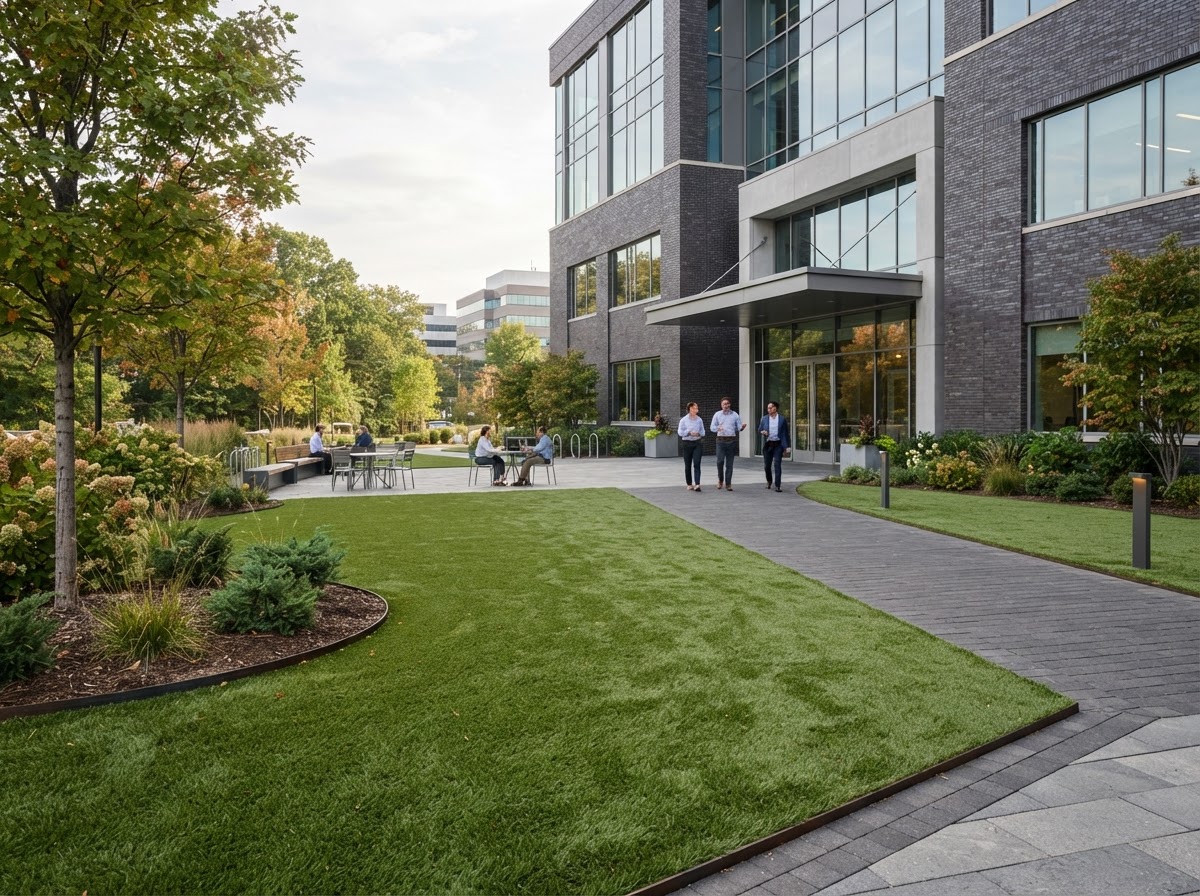
Commercial artificial turf covers business fronts, common areas, entries, courtyards and any property surface that sees regular foot traffic. The product, base and infill are selected for the use level, because a commercial entry sees very different wear than a residential lawn.
A commercial system is specified as a system — product, base, drainage and infill selected together for the traffic and exposure the site sees. A generic residential product applied to a commercial site is a common cause of premature wear, because it is not built for the intensity of daily commercial use.
Commercial projects also involve logistics that residential projects usually do not: phasing so the business can keep operating, access for material delivery on an active site, and coordination with existing infrastructure like irrigation, lighting and hardscape.
Who Needs Commercial Turf
Businesses and property managers who are tired of maintaining natural grass or mulch in a high-traffic commercial setting are the primary audience. A business front that turns muddy after rain, a common area that wears to bare dirt, or an entry that costs more to maintain than it returns are all common triggers.
Commercial turf also fits properties where a consistent, clean appearance matters to the business image — a tidy, green surface year-round reads as well-maintained to customers and tenants, without the weekly mowing and seasonal replanting a living lawn demands.
For property managers overseeing multiple sites, a durable turf system can simplify maintenance planning across properties, because the maintenance cycle is more predictable than natural grass that responds to weather and season.
How Foot Traffic Changes the System
Higher and more concentrated foot traffic changes the turf product, base and infill selection. A commercial entry where hundreds of people walk daily calls for a more durable product and a denser base than a backyard that sees a family of four.
The wear pattern matters too. A path between a parking lot and an entrance concentrates traffic in a narrow strip, which mats and wears faster than a broad area with dispersed traffic. The system is selected and laid out with those wear patterns in mind.
Infill selection is especially important on a commercial site, because infill affects how the fibers stand up to traffic and how the surface feels underfoot. A commercial system uses an infill matched to the use level, not a generic choice that may break down under daily wear.
Access and Phasing
Commercial sites often require phasing so the business can keep operating during installation. A full-site closure is rarely practical, so the work is planned in phases that keep access open to customers, tenants and deliveries throughout the project.
Access logistics shape how materials reach the surface and where equipment can stage. A downtown site with street-only access and limited staging space costs more to install than a suburban site with a parking lot for staging, because material handling takes longer and is more constrained.
These constraints are planned into the scope, not worked around. A commercial estimate that does not account for phasing and access is a warning sign that the logistics may not be handled, which can disrupt business operations during installation.
Drainage for a Commercial Site
Commercial sites often have larger drainage loads and more hardscape interfaces than residential properties. Drainage is planned for the whole site, not just the turf patch, because water moving across a commercial property affects multiple surfaces and structures.
A commercial surface that holds water is both a usability and a liability problem — standing water in a customer path or entry is a slip and access concern. The drainage plan accounts for the site grade, the surrounding hardscape and the volume of water the surface sees during rain.
Turf does not solve flooding. It manages surface water through a planned base and drainage path. If a commercial site has a broader stormwater or grading problem, that needs to be addressed as part of the project scope or by the appropriate professional.
What Affects Commercial Cost
For planning purposes, professionally installed artificial turf in the New York market often falls broadly around $6–$22 per square foot, while Long Island projects are frequently quoted toward roughly $12–$22 per square foot. These are market planning ranges, not a fixed Valley Stream Artificial Grass quote.
Commercial access, use level, preparation and drainage can push cost beyond standard residential ranges. A downtown site with limited access and phasing requirements costs more than an open suburban site, because the logistics add labor and time.
The use level shapes the product and infill recommendations — a high-traffic commercial entry calls for a more durable, more expensive product than a low-traffic common area. The estimate reflects the actual site, use level and logistics, not a square-footage number alone.
No claim is made that turf always produces a positive return on investment. Whether a commercial turf system pays off depends on the maintenance cost it replaces, the appearance value to the business, and how long the system performs — all of which are site-specific.
How Long a Commercial Project Takes
Commercial projects vary widely with area, access, phasing and the use level of the system. A phased installation on an active business site takes longer than a single-phase installation on a closed site, because each phase has to keep the business operating.
The preparation phase — removal, grading, base installation and compaction — usually takes the largest share of the time. Once the base is set, the turf layout, cutting, seaming, infill and grooming move more quickly, but phasing can extend the overall timeline across multiple visits.
Weather and access can affect scheduling on Long Island, particularly during the wetter and colder months. A commercial estimate includes a realistic timeline that accounts for phasing, access and weather, not just the raw installation time.
Maintenance Expectations for Commercial Turf
A commercial turf system is maintained through periodic grooming to redistribute infill in high-use areas, debris removal and inspection of seams and edges. High-traffic commercial sites may need more frequent grooming than a residential lawn, because the wear is concentrated and continuous.
Maintenance is a separate service from installation and is scoped based on the area, use level and condition of the turf. A commercial entry used daily may benefit from monthly grooming, while a low-traffic common area may need it less often.
Planning maintenance expectations during the estimate helps a property manager budget for the ongoing care of the system. A commercial turf system that is not maintained will mat, lose infill and develop wear patterns faster than one that is groomed on a schedule.
What Happens After I Request an Estimate?
After you request an estimate, we discuss the site, the use level and the access and phasing constraints, then evaluate dimensions, drainage and preparation before recommending a commercial turf system and scope. There is no obligation until you decide to move forward.
The estimate reflects the actual commercial site — the traffic, access, phasing, drainage and existing infrastructure — rather than a one-size square-footage number. A firm timeline and price are set after the site is evaluated, with phasing planned around the business's operating hours.
What Drives the Price
Published ranges are market planning references only, not a fixed Valley Stream Artificial Grass quote. The factors below shape your site-specific estimate:
- Area size / square footage
- Turf product selection
- Existing material removal
- Excavation depth
- Base preparation and compaction
- Grade and slope
- Drainage design
- Site access
- Curves, cuts and shape complexity
- Edging and perimeter detail
- Infill type and quantity
- Hardscape interfaces
- Use level and foot traffic
- Commercial access and staging
- Phasing requirements
- Wear-pattern layout
What to Ask Before Hiring
- How is the product selected for my foot-traffic level and wear patterns?
- How is drainage planned for the whole commercial site, not just the turf patch?
- How is access and phasing handled to keep the business operating?
- What are the maintenance expectations, and how often should high-use areas be groomed?
- How does the estimate account for staging space and material delivery on an active site?
- What does the final walkthrough cover before the surface goes into use?
Commercial Artificial Turf in Valley Stream
Valley Stream's mix of residential and commercial properties within approximately 3.48 square miles means commercial turf projects often sit close to active foot traffic and existing infrastructure. A business-front or common-area installation has to be planned around how customers, tenants and deliveries move across the surface every day, not just how it looks when it goes in.
Long Island weather brings rain, snow and freeze/thaw cycles, so drainage and a stable base are especially important for high-traffic commercial surfaces. A commercial system that holds water or develops a soft base becomes a liability during the colder months, when foot traffic and freeze cycles compound any weakness in the base or drainage path.
Valley Stream maintains its own Village Building Department for local permitting and zoning questions when a commercial project changes grading, drainage or regulated features. Commercial property owners should confirm requirements before work begins, because commercial scope often involves more regulated site work than a residential lawn.
On compact Long Island commercial sites, access logistics — how materials reach the surface, where equipment can stage, and whether the business can keep operating during installation — are common planning points that shape both cost and feasibility. Phasing is often required so a business does not have to close while the work proceeds.
Want a Number for Your Project?
Market ranges only go so far. Request a site-specific estimate or call to discuss scope.
How the Project Works
- 1
Request an estimate
- 2
Discuss intended use and site conditions
- 3
Evaluate dimensions, access, drainage and preparation
- 4
Review recommended turf system and scope
- 5
Schedule professional installation
- 6
Final walkthrough
Ready to Move Forward?
Call now or request an estimate to start the conversation about your property.
Why Work With Valley Stream Artificial Grass
10 Years of Experience
A decade of turf-focused installation, repair and maintenance work.
Insured
Insured for the work we perform on your property.
Approximately 30-Mile Service Area
Serving Valley Stream and selected Long Island communities within roughly 30 miles.
Site-Specific Estimates
Estimates reflect your actual property, grade, access and drainage — not a one-size number.
Turf-Focused Service Menu
Residential, pet, golf, sports, commercial, specialty, repair and maintenance.
Residential & Commercial
Experience across homes, businesses, schools, rooftops and specialty installations.
Commercial Artificial Turf — Frequently Asked Questions
How much does commercial artificial turf cost?
For planning purposes, professionally installed artificial turf in the New York market often falls broadly around $6–$22 per square foot, while Long Island projects are frequently quoted toward roughly $12–$22 per square foot. These are market planning ranges, not a fixed Valley Stream Artificial Grass quote. Commercial access, use level, preparation and drainage can push cost beyond residential ranges. A downtown site with limited access and phasing costs more than an open suburban site.
Is commercial turf different from residential?
Yes. Product, base and infill are selected for higher and more concentrated foot traffic. A generic residential product applied to a commercial site is a common cause of premature wear.
Can the business stay open during installation?
Often yes, through phasing. The work is planned in phases that keep access open to customers, tenants and deliveries throughout the project, rather than requiring a full-site closure.
How is drainage handled on a commercial site?
Drainage is planned for the whole site, not just the turf patch. A commercial surface that holds water is both a usability and a liability problem, so the plan accounts for site grade, surrounding hardscape and rain volume.
Does commercial turf always pay for itself?
No claim is made that turf always produces a positive return on investment. Whether it pays off depends on the maintenance cost it replaces, the appearance value to the business, and how long the system performs — all of which are site-specific.
How often does commercial turf need maintenance?
High-traffic commercial sites may need more frequent grooming than a residential lawn. A commercial entry used daily may benefit from monthly grooming, while a low-traffic common area may need it less often.
How long does a commercial turf project take?
It varies widely with area, access, phasing and use level. A phased installation on an active site takes longer than a single-phase installation on a closed site, because each phase keeps the business operating.
Request Your Artificial Turf Estimate
Tell us about your property and what you're hoping to solve. We'll follow up to schedule a site-specific evaluation.
Prefer to talk now?
516-963-5452Request a Turf Estimate
Tell us about your property. We'll follow up to schedule a site-specific evaluation.
Serving Valley Stream & Long Island
Valley Stream Artificial Grass serves residential and commercial turf projects in Valley Stream and selected communities within approximately 30 miles.
Targeted Communities
Other properties within the approximately 30-mile radius may be considered based on project location.
View all service areas →