Turf Repair & Maintenance
Artificial Turf Drainage Repair in Valley Stream, NY
Valley Stream Artificial Grass diagnoses and repairs standing water, slow drainage, repeated wet areas and base settlement by correcting the failed drainage path — not just removing the surface water.
Drainage repair that corrects the failed path beneath the surface, not just the standing-water symptom on top.
Request a Turf Estimate
Tell us about your project. We'll follow up to schedule a site-specific evaluation.
Who Should Call
Standing water, slow drainage, repeated wet areas or base settlement on an existing turf system.
The Outcome
A corrected drainage path that moves water away from the surface and surrounding structures.
Best For
Owners of turf with persistent drainage problems.
What Causes Drainage Problems in Artificial Turf
Drainage problems usually have a cause — base settlement, a blocked or inadequate drainage path, a grade that has shifted, or compaction that prevents water from moving through. The visible turf may not be the core problem; grade, base, drainage route, compaction or surrounding hardscape can all contribute.
Standing water on a turf surface is a symptom, not the diagnosis. The water is pooling because something beneath or around the surface is preventing it from moving away, and identifying that something is the first step in a repair that actually solves the problem.
On Long Island properties, freeze/thaw cycles and heavy rain can accelerate drainage failures. A drainage path that worked initially can fail over time as the base settles, compacts or shifts, especially if the original installation did not fully account for the site's grade and soil conditions.
Signs You Need Drainage Repair
Visible signs include standing water on the turf surface after rain, slow drainage that leaves the surface wet long after precipitation stops, repeated wet areas that never fully dry, and base settlement that creates soft or spongy spots.
Less obvious signs include water moving toward unwanted areas — toward a foundation, walkway or neighboring property — or a change in how the surrounding hardscape drains after the turf was installed. These can indicate that the turf system is redirecting water in ways the original drainage plan did not intend.
Odor can also be a sign, particularly on pet turf where standing water combines with pet waste to create a persistent smell. If a pet turf system that previously drained well begins to hold water or develop odor, the drainage path may have failed.
Drainage Diagnosis
Drainage diagnosis begins with an on-site inspection that evaluates the surface, the base where accessible, the drainage path and the surrounding grade. The goal is to identify where water is entering the system, where it should be going, and what is preventing it from getting there.
The diagnosis considers the existing grade, the soil type, the base material and compaction, the drainage route and any surrounding hardscape or structures that affect water flow. Each of these can contribute to a drainage failure, and the inspection identifies which factor — or combination of factors — is driving the problem.
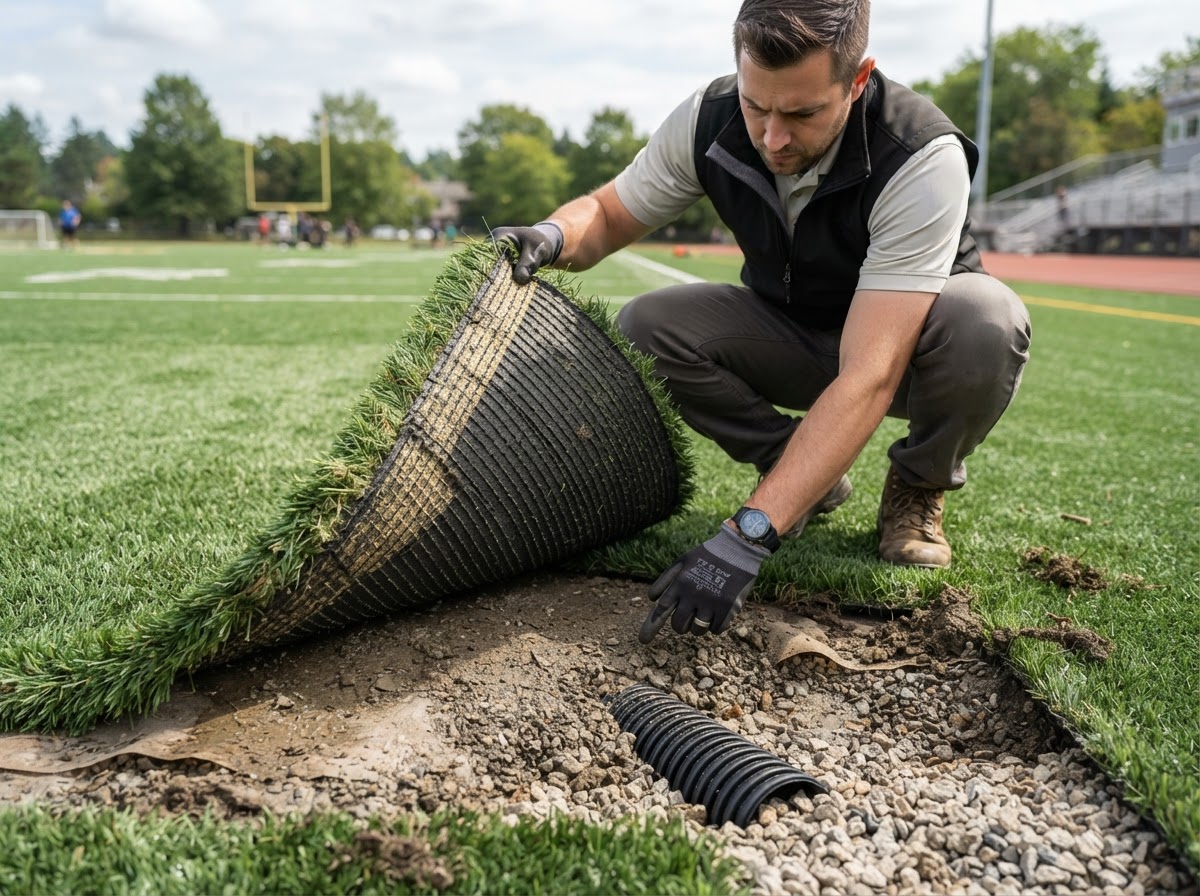
Not every drainage issue can be solved without removing turf. Some require accessing the base beneath the surface to correct settlement, compaction or the drainage route, which means lifting a section of turf, correcting the base and re-installing the surface.
How Much Does Drainage Repair Cost?
National market planning references may place turf repair and replacement around roughly $2–$10 per square foot where per-square-foot pricing applies, but actual repair work is often scope-based because the underlying cause matters more than the square footage. These are planning references, not a fixed Valley Stream Artificial Grass quote.
Drainage repair is scope-based because the correction depends on the cause. A drainage path that can be corrected from the surface — clearing a blocked route or adjusting an edge — is at the lower end. A repair that requires lifting turf to correct base settlement or rebuild the drainage path is at the higher end.
The diagnosis is the key step that determines the scope. Without identifying the cause, a drainage repair is a guess, and a guessed repair often fails because it addresses the symptom rather than the path that is actually failing.
What the Drainage Repair Process Includes
Professional drainage repair begins with an on-site diagnosis of the cause — where water is entering, where it should go, and what is blocking the path. The diagnosis evaluates the surface, the base, the drainage route and the surrounding grade.
Once the cause is identified, the repair scope is recommended. Surface-level corrections — clearing a blocked path, adjusting an edge or re-grading a surface feature — can be done without lifting turf. Base-level corrections — settlement, compaction, or a drainage route that needs to be rebuilt — require lifting a section of turf to access and correct the base.
A final walkthrough confirms the drainage path is working — water moves away from the surface and surrounding structures as intended — before the repair is considered complete. The goal is a drainage path that performs, not just a surface that looks dry on the day of the repair.
How Long Does Drainage Repair Take?
Surface-level drainage corrections can often be completed in a single visit. Repairs that require lifting turf to access and correct the base take longer, because the base work — settlement correction, compaction, drainage route rebuilding — is the time-consuming part.
The diagnosis phase is quick; the repair time depends on the scope. A straightforward path clearance is fast, while a base rebuild that requires lifting a section of turf, correcting the drainage route and re-installing the surface may require multiple visits.
Weather can affect both the diagnosis and the repair. Drainage problems are most visible during wet weather, but base work may need to wait for drier conditions to ensure the correction is done properly.
Can Drainage Be Fixed Without Removing the Turf?
Sometimes, but not always. Surface-level drainage issues — a blocked path, an edge that traps water, a surface feature that redirects flow — can often be corrected without lifting the turf.
Base-level drainage issues — settlement, compaction, or a drainage route that was inadequate from the start — usually require lifting a section of turf to access and correct the base beneath. Attempting to fix a base-level problem from the surface alone does not address the cause and the problem will recur.
An honest diagnosis tells you which situation you are in. A drainage repair that claims to fix everything from the surface without inspecting the base is a warning sign that the cause may not be fully identified.
What Happens After I Request an Inspection?
After you request an inspection, we visit the property to diagnose the cause of the drainage problem — evaluating the surface, the base, the drainage path and the surrounding grade. The recommendation identifies the cause and the scope required to correct it.
There is no obligation until you decide to move forward. A firm timeline and price are set after the diagnosis, with the cause addressed as part of the scope so the drainage path performs, not just the symptom removed.
What Drives the Price
Published ranges are market planning references only, not a fixed Valley Stream Artificial Grass quote. The factors below shape your site-specific estimate:
- Diagnosis scope
- Drainage correction required
- Base condition
- Whether turf must be lifted
- Access to the affected area
- Surrounding grade and hardscape
What to Ask Before Hiring
- What is the underlying cause of the standing water?
- Can the drainage path be corrected without removing the turf?
- Has the grade or base shifted since the original installation?
- How is the corrected drainage path verified before the repair is complete?
- Will the repair require lifting a section of turf to access the base?
- What happens if the drainage problem is caused by something beyond the turf system itself?
Drainage Repair in Valley Stream
Valley Stream's owner-occupied properties — roughly 78.7% owner occupancy — mean many owners notice turf issues early and want them diagnosed before they spread. Long Island weather brings rain, snow and freeze/thaw cycles that can stress seams, edges and drainage paths over time, making early inspection valuable on properties that see all four seasons.
Valley Stream maintains its own Village Building Department for local permitting and zoning questions when a repair project changes grading, drainage or regulated features. A repair that involves correcting drainage or re-grading may require confirmation with the local authority before work begins.
On compact Long Island lots, a small turf problem can affect a disproportionate share of the usable yard, which is why early diagnosis matters. A lifted edge or separating seam on a small property is more visible and more disruptive than the same issue on a large estate, and it can limit use of the yard until it is corrected.
Want a Number for Your Project?
Market ranges only go so far. Request a site-specific estimate or call to discuss scope.
How the Project Works
- 1
Request an inspection
- 2
Describe the symptoms and when they started
- 3
On-site diagnosis of the cause
- 4
Recommended scope: repair, maintenance or replacement
- 5
Schedule the work
- 6
Final walkthrough
Ready to Move Forward?
Call now or request an estimate to start the conversation about your property.
Why Work With Valley Stream Artificial Grass
10 Years of Experience
A decade of turf-focused installation, repair and maintenance work.
Insured
Insured for the work we perform on your property.
Approximately 30-Mile Service Area
Serving Valley Stream and selected Long Island communities within roughly 30 miles.
Site-Specific Estimates
Estimates reflect your actual property, grade, access and drainage — not a one-size number.
Turf-Focused Service Menu
Residential, pet, golf, sports, commercial, specialty, repair and maintenance.
Residential & Commercial
Experience across homes, businesses, schools, rooftops and specialty installations.
Drainage Repair — Frequently Asked Questions
How does artificial turf drain?
Through a planned base and drainage path that moves water away from the surface and surrounding structures. When that path fails — through settlement, compaction, blockage or a shifted grade — drainage repair corrects the path so water moves as intended.
How much does drainage repair cost?
National market planning references may place turf repair and replacement around roughly $2–$10 per square foot where per-square-foot pricing applies, but actual repair work is often scope-based because the underlying cause matters more than the square footage. These are planning references, not a fixed Valley Stream Artificial Grass quote. Drainage repair is scope-based; the correction depends on the cause. A surface-level correction is at the lower end; a repair requiring base work beneath the turf is at the higher end.
Can drainage be fixed without removing the turf?
Sometimes, for surface-level issues. Base-level issues — settlement, compaction, or an inadequate drainage route — usually require lifting a section of turf to access and correct the base. Not every drainage issue can be solved without removing turf.
What causes standing water on artificial turf?
Base settlement, a blocked or inadequate drainage path, a shifted grade, or compaction that prevents water from moving through. The standing water is a symptom; the cause is beneath or around the surface and requires diagnosis before repair.
How long does drainage repair take?
Surface-level corrections can often be completed in a single visit. Repairs that require lifting turf to correct the base take longer and may require multiple visits, because the base work is the time-consuming part.
Will the drainage problem come back after repair?
Not if the cause is corrected. A repair that addresses the failed drainage path — not just the standing water — prevents recurrence. A repair that only removes the surface water without fixing the path will fail again.
Does artificial turf cause drainage problems?
Turf itself does not cause drainage problems, but an improperly planned or installed system can fail to manage water correctly. The drainage path, base and grade all have to work together, and a failure in any one can cause standing water.
Request Your Artificial Turf Estimate
Tell us about your property and what you're hoping to solve. We'll follow up to schedule a site-specific evaluation.
Prefer to talk now?
516-963-5452Request a Turf Estimate
Tell us about your property. We'll follow up to schedule a site-specific evaluation.
Serving Valley Stream & Long Island
Valley Stream Artificial Grass serves residential and commercial turf projects in Valley Stream and selected communities within approximately 30 miles.
Targeted Communities
Other properties within the approximately 30-mile radius may be considered based on project location.
View all service areas →