Turf Repair & Maintenance
Artificial Turf Seam & Edge Repair in Valley Stream, NY
Valley Stream Artificial Grass repairs separating seams, raised edges, loose perimeters and localized trip concerns — addressing the cause early before a small separation becomes a larger failure.
Early seam and edge repair that stops small separations from becoming larger, more expensive failures.
Request a Turf Estimate
Tell us about your project. We'll follow up to schedule a site-specific evaluation.
Who Should Call
A separating seam, raised edge, loose perimeter or localized trip concern on existing turf.
The Outcome
Secure seams and edges that restore a safe, consistent surface and prevent the separation from spreading.
Best For
Owners of turf with separating seams or lifting edges.
Why Seams and Edges Fail
Separating seams and raised edges tend to worsen with traffic and weather. The cause is often base movement, inadequate securing, or installation detail — and identifying which of these is driving the failure determines the right repair approach.
A seam separates when the joining method fails, when the base beneath the seam shifts, or when traffic and weather stress the connection beyond what it was designed to hold. An edge lifts when the perimeter securing is inadequate, when the base beneath the edge settles, or when drainage washes out the base material supporting the edge.
On Long Island properties, freeze/thaw cycles can accelerate seam and edge failures. Water that enters a seam or beneath an edge during the warmer months can freeze and expand in winter, widening the separation and making early repair even more valuable.
Signs You Need Seam or Edge Repair
Visible signs include seam separation — a visible gap where two sections of turf meet — raised or lifting edges along the perimeter, a loose perimeter that moves underfoot, and movement in the surface when walked on.
A localized trip concern is a more serious sign. When a seam or edge lifts enough to create a trip hazard, the repair is no longer just about appearance — it is about safety, and the repair should be scheduled promptly.
Less obvious signs include a seam that feels raised underfoot even if the separation is not yet visible from a distance, or an edge that has begun to pull away from its securing point. These early signs are the best time to schedule repair, before the separation widens.
How Much Does Seam & Edge Repair Cost?
National market planning references may place turf repair and replacement around roughly $2–$10 per square foot where per-square-foot pricing applies, but actual repair work is often scope-based because the underlying cause matters more than the square footage. These are planning references, not a fixed Valley Stream Artificial Grass quote.
Cost depends on the affected seam or edge length and the underlying cause. A short seam re-securing on a sound base is at the lower end; a long perimeter edge that requires base correction beneath it is at the higher end.
Seam and edge work is often priced by the length and condition of the affected area rather than by square footage, because the repair is linear — it follows the seam or edge, not the surface area. The estimate reflects the actual length, cause and condition.
What the Repair Process Includes
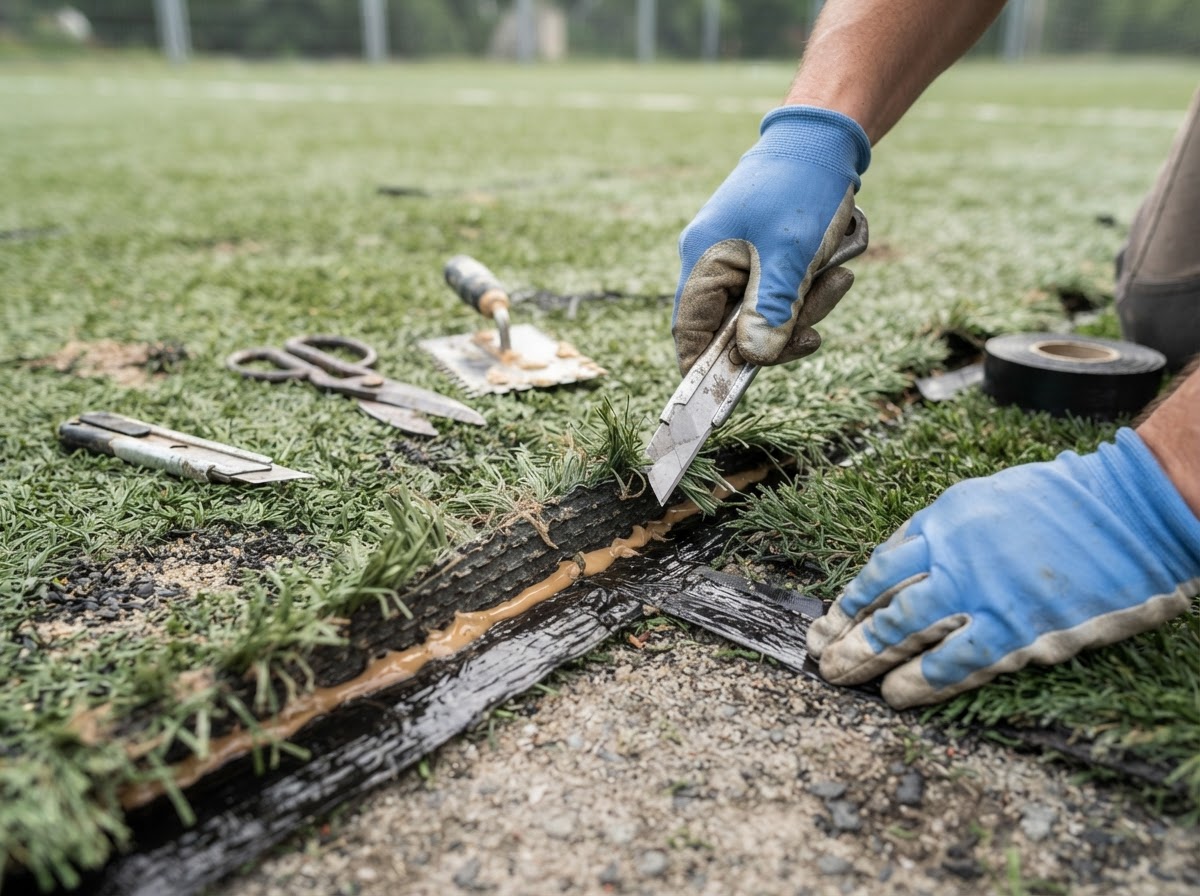
Professional seam and edge repair begins with an on-site inspection to identify the cause of the separation. The inspection evaluates the seam or edge, the securing method, the base beneath and the drainage path to determine what is driving the failure.
Once the cause is identified, the repair re-secures the seam or edge using a method appropriate to the cause. If the base beneath has settled or washed out, the base is corrected before the seam or edge is re-secured, so the repair addresses the cause and prevents recurrence.
A final walkthrough confirms the seam or edge is secure, the surface is consistent and the underlying cause has been addressed. The goal is a repair that holds, not just a repair that looks finished on the day of the visit.
How Long Does Seam & Edge Repair Take?
Most seam and edge repairs can be completed in a single visit, particularly when the base beneath is sound and the repair is a re-securing. Repairs that require base correction beneath the seam or edge take longer, because the base work is the time-consuming part.
The length of the affected seam or edge affects the timeline — a short seam is faster than a long perimeter edge. Weather can affect scheduling on Long Island, particularly during wetter months when base work may need to wait for drier conditions.
Will the Repair Be Visible?
An invisible repair is not promised. The goal is a secure, safe, consistent surface that stops the separation from spreading, and the priority is addressing the cause over achieving a perfectly invisible seam.
A targeted repair on matching turf, using the appropriate securing method, is often barely visible from a distance. However, the repair's primary purpose is to restore a safe, usable surface and prevent the separation from worsening — not to achieve a cosmetic match that compromises the structural repair.
If the appearance of the repair is a concern, discuss it during the inspection. The repair approach can take appearance into account, but not at the expense of addressing the cause and securing the seam or edge properly.
Why Early Evaluation Matters
Early evaluation can prevent a localized issue from becoming more extensive. A seam separation caught early is a simpler, less expensive repair than the same seam after a full season of traffic has widened it into a gap that requires more material and more base work to correct.
The same applies to edges. A slightly lifted edge is a straightforward re-securing; an edge that has been left long enough for the base beneath to wash out requires base correction before the edge can be re-secured, which is a larger scope.
On Long Island, the freeze/thaw cycle makes early repair especially valuable. Water that enters a separation during the warmer months can freeze and expand in winter, widening the gap and turning a simple repair into a larger one. Scheduling repair before winter is often the most cost-effective approach.
What Happens After I Request an Inspection?
After you request an inspection, we visit the property to diagnose the cause of the seam or edge separation, then recommend a scope that addresses both the visible symptom and the underlying cause. There is no obligation until you decide to move forward.
The recommendation identifies the cause, the affected length and the repair approach, so you can make an informed decision. A firm timeline and price are set after the inspection, with the cause addressed as part of the scope.
What Drives the Price
Published ranges are market planning references only, not a fixed Valley Stream Artificial Grass quote. The factors below shape your site-specific estimate:
- Affected seam/edge length
- Underlying cause
- Base condition beneath the seam or edge
- Access to the affected area
- Whether base correction is required
What to Ask Before Hiring
- What caused the seam or edge to separate?
- How are seams and edges re-secured to prevent recurrence?
- Is the base sound beneath the separation, or does it need correction?
- Will the repair be visible, and what will it look like?
- How long is the affected seam or edge, and how does that affect the scope?
- Should I schedule this before winter to avoid freeze/thaw damage?
Seam & Edge Repair in Valley Stream
Valley Stream's owner-occupied properties — roughly 78.7% owner occupancy — mean many owners notice turf issues early and want them diagnosed before they spread. Long Island weather brings rain, snow and freeze/thaw cycles that can stress seams, edges and drainage paths over time, making early inspection valuable on properties that see all four seasons.
Valley Stream maintains its own Village Building Department for local permitting and zoning questions when a repair project changes grading, drainage or regulated features. A repair that involves correcting drainage or re-grading may require confirmation with the local authority before work begins.
On compact Long Island lots, a small turf problem can affect a disproportionate share of the usable yard, which is why early diagnosis matters. A lifted edge or separating seam on a small property is more visible and more disruptive than the same issue on a large estate, and it can limit use of the yard until it is corrected.
Want a Number for Your Project?
Market ranges only go so far. Request a site-specific estimate or call to discuss scope.
How the Project Works
- 1
Request an inspection
- 2
Describe the symptoms and when they started
- 3
On-site diagnosis of the cause
- 4
Recommended scope: repair, maintenance or replacement
- 5
Schedule the work
- 6
Final walkthrough
Ready to Move Forward?
Call now or request an estimate to start the conversation about your property.
Why Work With Valley Stream Artificial Grass
10 Years of Experience
A decade of turf-focused installation, repair and maintenance work.
Insured
Insured for the work we perform on your property.
Approximately 30-Mile Service Area
Serving Valley Stream and selected Long Island communities within roughly 30 miles.
Site-Specific Estimates
Estimates reflect your actual property, grade, access and drainage — not a one-size number.
Turf-Focused Service Menu
Residential, pet, golf, sports, commercial, specialty, repair and maintenance.
Residential & Commercial
Experience across homes, businesses, schools, rooftops and specialty installations.
Seam & Edge Repair — Frequently Asked Questions
What causes seams to separate?
Often base movement, inadequate securing or installation detail. Traffic and weather worsen separations over time, and on Long Island the freeze/thaw cycle can accelerate the widening by freezing water that enters the gap.
How much does seam and edge repair cost?
National market planning references may place turf repair and replacement around roughly $2–$10 per square foot where per-square-foot pricing applies, but actual repair work is often scope-based because the underlying cause matters more than the square footage. These are planning references, not a fixed Valley Stream Artificial Grass quote. Cost depends on the affected length and cause. Seam and edge work is often priced by the length and condition of the affected area rather than by square footage.
Will the repair be visible?
An invisible repair is not promised. The goal is a secure, safe, consistent surface that stops the separation from spreading. A targeted repair on matching turf is often barely visible, but the priority is addressing the cause.
How long does seam and edge repair take?
Most repairs can be completed in a single visit when the base is sound. Repairs that require base correction beneath the seam or edge take longer, because the base work is the time-consuming part.
Why should I repair a small seam separation early?
Because separations worsen with traffic, weather and time. A small separation caught early is a simpler, less expensive repair than the same gap after a full season of traffic and freeze/thaw has widened it.
What causes edges to lift?
Inadequate perimeter securing, base settlement beneath the edge, or drainage washing out the base material. Each cause calls for a different repair approach, which is why diagnosis comes before the repair plan.
Is a lifting edge a safety concern?
It can be. When a seam or edge lifts enough to create a trip hazard, the repair is about safety as well as appearance. A trip concern should be scheduled promptly rather than left to worsen.
Request Your Artificial Turf Estimate
Tell us about your property and what you're hoping to solve. We'll follow up to schedule a site-specific evaluation.
Prefer to talk now?
516-963-5452Request a Turf Estimate
Tell us about your property. We'll follow up to schedule a site-specific evaluation.
Serving Valley Stream & Long Island
Valley Stream Artificial Grass serves residential and commercial turf projects in Valley Stream and selected communities within approximately 30 miles.
Targeted Communities
Other properties within the approximately 30-mile radius may be considered based on project location.
View all service areas →