Commercial & Specialty Turf
Rooftop Artificial Turf in Valley Stream, NY
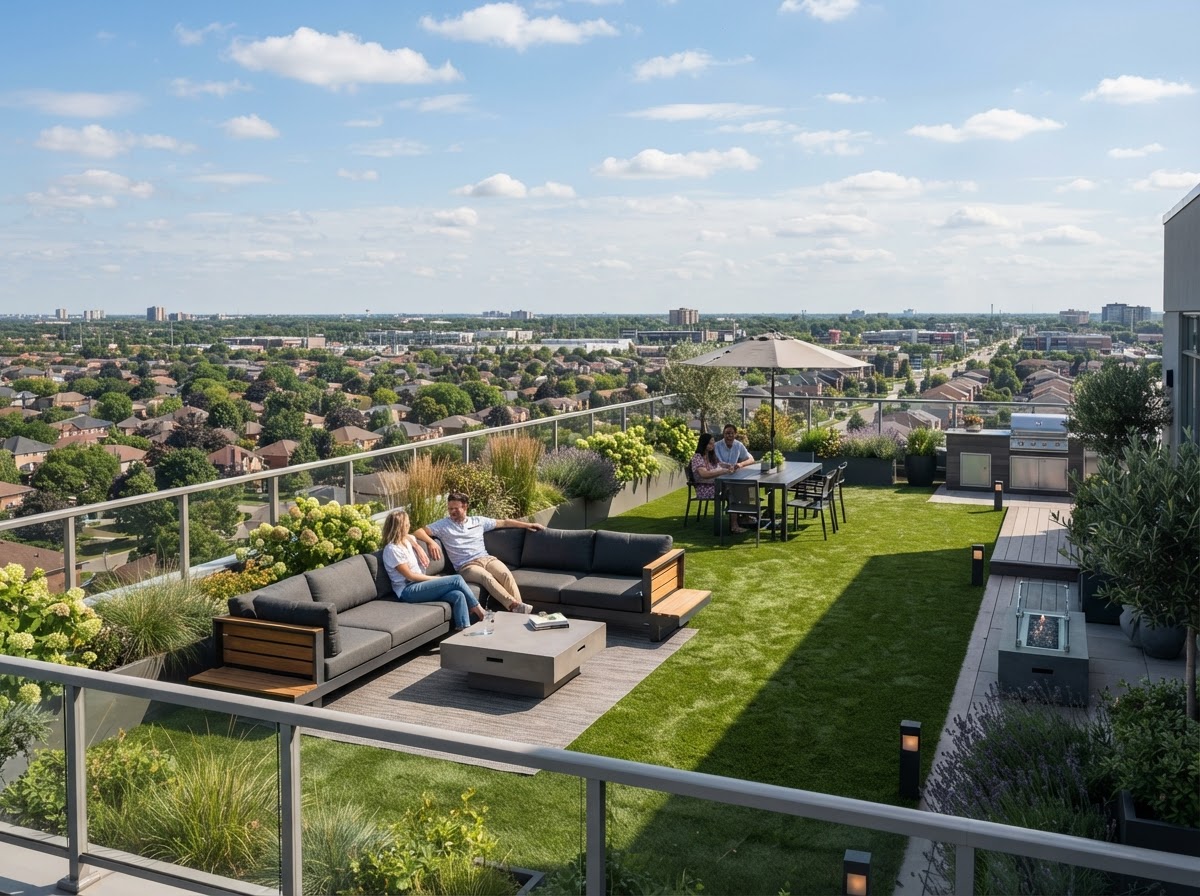
Valley Stream Artificial Grass installs rooftop artificial turf for amenity terraces and rooftop recreation, where access, drainage, weight and load restrictions and edge details shape the system and structural requirements are evaluated separately.
A rooftop turf system planned around access, drainage and load — with building and structural requirements evaluated by the appropriate professionals, not assumed.
Request a Turf Estimate
Tell us about your project. We'll follow up to schedule a site-specific evaluation.
Who Should Call
An amenity terrace, rooftop recreation area or rooftop green space.
The Outcome
A clean, usable rooftop surface that respects access and load constraints and integrates with the building's drainage.
Best For
Property owners and managers adding turf to a suitable rooftop or terrace.
What Rooftop Turf Covers
Rooftop artificial turf covers amenity terraces, rooftop recreation areas and rooftop green spaces. The system depends on access — how materials reach the surface — drainage, weight and load restrictions, and edge details that respect the building's perimeter.
A rooftop system is specified differently from a ground-level installation. The base, drainage and anchoring all have to account for the fact that the surface sits on a building, not on grade, and that the building's structure and drainage paths are part of the system.
Building and structural requirements must be evaluated separately where applicable. No structural-load claims are made here — the building must be suitable for the load, and that suitability is confirmed by the appropriate professionals, not assumed by the turf installer.
Who Needs Rooftop Turf
Property owners and managers adding an amenity terrace, rooftop recreation area or rooftop green space are the primary audience. A rooftop that is underused because the surface is bare or difficult to maintain is a common trigger for considering a turf system.
A rooftop turf surface can turn an unused roof into a usable amenity space — for seating, recreation or simply a greener appearance — without the weight and maintenance of a rooftop lawn built on soil.
Rooftop turf is not appropriate for every roof. The building's structural capacity, drainage paths and perimeter conditions all have to be suitable, and those are evaluated before any system is recommended.
Access and Material Delivery
Rooftop access is often the single biggest logistical factor. How materials reach the surface — by elevator, crane or stair — shapes both cost and feasibility, and a roof with difficult access costs more to install than one with straightforward access.
Material delivery to a roof is constrained by the building's layout, weight limits on elevators, and whether a crane can reach the surface. These constraints are evaluated as part of the estimate, because they can make or break a project's feasibility.
Access also affects the timeline. A roof that can only be reached by a small elevator with limited weight capacity requires more trips and more labor time than one with crane access, and the estimate reflects that.
Drainage on a Roof
Rooftop drainage is planned so water moves off the roof through the building's existing drainage paths, not pooling on or beneath the turf. The existing roof surface, drainage outlets and perimeter conditions all shape the drainage design.
A rooftop turf system that traps water or redirects it incorrectly can damage the roof membrane or the building below, which is why drainage is planned alongside the base work and respects the building's existing drainage infrastructure.
The drainage plan accounts for the roof's slope, the existing outlets and the volume of water the surface sees. A flat roof with limited outlets needs a different drainage approach than a sloped roof with multiple drainage paths.
Weight, Load and Structural Evaluation
Weight and load restrictions are central to a rooftop system. The turf, base and any infill add weight to the roof, and the building's structural capacity must be evaluated to confirm it can carry that load — a evaluation performed by the appropriate professionals, not the turf installer.
No structural-load claims are made here. The building must be suitable for the load, and if it is not, the system has to be adjusted — lighter materials, a different base, or no infill — or the project may not be feasible.
Wind is also a consideration at a general level. A rooftop surface is exposed to wind that a ground-level installation is not, and the anchoring and edge details are planned with that exposure in mind so the surface stays secure.
Perimeter and Edge Details
Rooftop perimeter conditions — parapets, railings, membrane edges — shape the edge details of the turf system. The edges are planned to respect the building's perimeter and to stay secure in wind exposure, not just to look finished.
Where the turf meets a parapet, railing or membrane edge, the transition is planned so it does not stress the building's perimeter or create a lifting edge in wind. Rooftop edges see forces a ground-level installation does not, so the securing is specified for that exposure.
The perimeter details also affect drainage, because the edge is where water exits the surface into the building's drainage path. A poorly planned edge can trap water or redirect it incorrectly, which is why edge and drainage planning go together.
What Affects Rooftop Cost
For planning purposes, professionally installed artificial turf in the New York market often falls broadly around $6–$22 per square foot, while Long Island projects are frequently quoted toward roughly $12–$22 per square foot. These are market planning ranges, not a fixed Valley Stream Artificial Grass quote.
Rooftop access, load restrictions, drainage and edge detailing can push cost well above standard ground-level ranges. A roof with crane access and a suitable structure is closer to standard ranges; a roof with elevator-only access and load constraints is at the higher end.
The structural evaluation — performed by the appropriate professionals — is a separate cost from the turf installation, and its findings can change the system recommended. A roof that needs a lighter system because of load limits may cost more per square foot for the materials.
The estimate reflects the actual roof — access, structure, drainage and perimeter — rather than a square-footage number alone. A rooftop estimate that does not account for access and load is a warning sign that the logistics may not be handled.
What Happens After I Request an Estimate?
After you request an estimate, we discuss the roof, the access and the intended use, then evaluate the surface, drainage and perimeter before recommending a system and scope. Building and structural requirements are evaluated separately by the appropriate professionals where applicable.
The estimate reflects the actual roof — access, load, drainage and edge details — rather than a one-size square-footage number. A firm timeline and price are set after the roof is evaluated and, where required, the structural evaluation is complete.
What Drives the Price
Published ranges are market planning references only, not a fixed Valley Stream Artificial Grass quote. The factors below shape your site-specific estimate:
- Area size / square footage
- Turf product selection
- Existing material removal
- Excavation depth
- Base preparation and compaction
- Grade and slope
- Drainage design
- Site access
- Curves, cuts and shape complexity
- Edging and perimeter detail
- Infill type and quantity
- Hardscape interfaces
- Rooftop access (elevator, crane, stair)
- Weight / load restrictions
- Edge and perimeter details
- Wind exposure
What to Ask Before Hiring
- Has the building's structural capacity been evaluated for the load, and by whom?
- How do materials reach the roof surface, and what does that access cost?
- How is drainage planned so water moves off the roof through existing paths?
- How are perimeter and edge details handled against wind exposure?
- What happens if the structural evaluation shows the roof cannot carry the load?
- Is a lighter system available if weight restrictions require it?
Rooftop Artificial Turf in Valley Stream
Valley Stream's mix of residential and commercial properties within approximately 3.48 square miles means commercial turf projects often sit close to active foot traffic and existing infrastructure. A business-front or common-area installation has to be planned around how customers, tenants and deliveries move across the surface every day, not just how it looks when it goes in.
Long Island weather brings rain, snow and freeze/thaw cycles, so drainage and a stable base are especially important for high-traffic commercial surfaces. A commercial system that holds water or develops a soft base becomes a liability during the colder months, when foot traffic and freeze cycles compound any weakness in the base or drainage path.
Valley Stream maintains its own Village Building Department for local permitting and zoning questions when a commercial project changes grading, drainage or regulated features. Commercial property owners should confirm requirements before work begins, because commercial scope often involves more regulated site work than a residential lawn.
On compact Long Island commercial sites, access logistics — how materials reach the surface, where equipment can stage, and whether the business can keep operating during installation — are common planning points that shape both cost and feasibility. Phasing is often required so a business does not have to close while the work proceeds.
Want a Number for Your Project?
Market ranges only go so far. Request a site-specific estimate or call to discuss scope.
How the Project Works
- 1
Request an estimate
- 2
Discuss intended use and site conditions
- 3
Evaluate dimensions, access, drainage and preparation
- 4
Review recommended turf system and scope
- 5
Schedule professional installation
- 6
Final walkthrough
Ready to Move Forward?
Call now or request an estimate to start the conversation about your property.
Why Work With Valley Stream Artificial Grass
10 Years of Experience
A decade of turf-focused installation, repair and maintenance work.
Insured
Insured for the work we perform on your property.
Approximately 30-Mile Service Area
Serving Valley Stream and selected Long Island communities within roughly 30 miles.
Site-Specific Estimates
Estimates reflect your actual property, grade, access and drainage — not a one-size number.
Turf-Focused Service Menu
Residential, pet, golf, sports, commercial, specialty, repair and maintenance.
Residential & Commercial
Experience across homes, businesses, schools, rooftops and specialty installations.
Rooftop Artificial Turf — Frequently Asked Questions
Can turf go on any rooftop?
No. Building and structural requirements must be evaluated separately where applicable. Artificial turf cannot be placed on every roof — the building must be suitable for the load, and that suitability is confirmed by the appropriate professionals.
How much does rooftop turf cost?
For planning purposes, professionally installed artificial turf in the New York market often falls broadly around $6–$22 per square foot, while Long Island projects are frequently quoted toward roughly $12–$22 per square foot. These are market planning ranges, not a fixed Valley Stream Artificial Grass quote. Rooftop access, load restrictions, drainage and edge detailing can push cost well above standard ranges. A roof with difficult access costs more to install than one with straightforward access.
Who evaluates the building's structural capacity?
The structural evaluation is performed by the appropriate professionals, not the turf installer. No structural-load claims are made here — the building must be suitable for the load, confirmed by that evaluation.
How is drainage handled on a rooftop?
Drainage is planned so water moves off the roof through the building's existing drainage paths, not pooling on or beneath the turf. The existing roof surface, drainage outlets and perimeter conditions all shape the design.
Does wind affect a rooftop turf system?
Yes, at a general level. A rooftop surface is exposed to wind that a ground-level installation is not, and the anchoring and edge details are planned with that exposure in mind so the surface stays secure.
What happens if the roof cannot carry the load?
The system is adjusted — lighter materials, a different base, or no infill — or the project may not be feasible. The structural evaluation's findings can change the system recommended, which is why it is done before a firm scope is set.
How do materials get to a rooftop?
By elevator, crane or stair, depending on the building. Access is often the single biggest logistical factor, and a roof with difficult access costs more to install than one with straightforward access.
Request Your Artificial Turf Estimate
Tell us about your property and what you're hoping to solve. We'll follow up to schedule a site-specific evaluation.
Prefer to talk now?
516-963-5452Request a Turf Estimate
Tell us about your property. We'll follow up to schedule a site-specific evaluation.
Serving Valley Stream & Long Island
Valley Stream Artificial Grass serves residential and commercial turf projects in Valley Stream and selected communities within approximately 30 miles.
Targeted Communities
Other properties within the approximately 30-mile radius may be considered based on project location.
View all service areas →